Talking Giants Baseball: A San Francisco Giants/Baseball Blog: Preview/Prediction
Showing posts with label Preview/Prediction. Show all posts

Thursday, March 24, 2011

San Francisco Giants Roster Predictions: Sorting Out the Crowded Outfield

The San Francisco Giants may become just a little less crowded in the outfield on Opening Day.

The Giants suffered a big blow during Wednesday's spring training contest against the Los Angeles Angels, who won the game 8-0. The score and Matt Cain's atrocious start were the least of the Giants' concerns, as
Cody Ross pulled up lame coming in on a line drive to right field.


GLENDALE, AZ - MARCH 04:  Outfielder Cody Ross #13 of the San Francisco Giants catches a fly ball out against the Los Angeles Dodgers during the spring training game at Camelback Ranch on March 4, 2011 in Glendale, Arizona.  (Photo by Christian Petersen/Getty Images)
When healthy, Ross is a good right fielder.
Christian Petersen/Getty Images


Ross left the game in the first inning with a strained right calf muscle. According to MLB.com, his immediate playing status remains uncertain, pending the results of an MRI Thursday, but playing on Opening Day against the Los Angeles Dodgers may be questionable.

Bochy has some interesting options in filling Ross' spot. Will rookie Brandon Belt or the maligned veteran Aaron Rowand benefit from Ross' injury?

Assuming Ross is unable to start the season, here is the current state of the Giants' outfield as the Giants break camp next week.

Andres Torres
It seems as if he is penciled in to be the starting center fielder, even if Rowand replaces Ross on the field. Bochy has inserted Rowand in the corner outfield positions this spring to prepare for a change from his native center field position.

Pat Burrell
Mychael Urban of CSNBayArea.com said he believes Burrell was the front-runner to start in left field before Ross' injury. Urban also said that Brandon Belt may start at first base with Aubrey Huff moving to the outfield.

Aubrey Huff
With Ross' injury, Huff just might be patrolling a corner outfield position in next Thursday's opener. Urban added that the Giants like Belt's bat and are confident he can handle first base. This appears to be the likely scenario if Belt continues to play well for the rest of spring training.

Aaron Rowand
His hitting is atrocious, but he has a decent glove. He will have a shot to prove himself with Ross' injury, as the Giants will probably move people around until Ross comes back.
109859029_crop_340x234
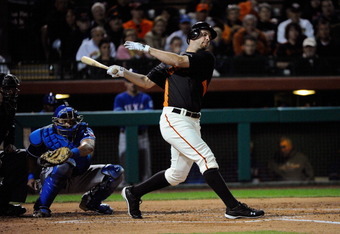
  Brandon Belt could start at first base next week at Dodger Stadium.
  Kevork Djansezian/Getty Images

Nate Schierholtz
He is an exceptional fielder with a great arm, but he is out of options. Because of this, Urban said he might be given a shot to start right field. From an offensive standpoint, Huff in right field and Burrell in left make the most sense.

Mark DeRosa
He played some left field for the Giants in 2010, but the team would rather have him bounce around the infield. However, DeRosa has hit the ball hard this spring and could force himself into the lineup, whether in the outfield or the infield (with Huff moving to the outfield).

Cody Ross
Do not completely rule out Ross. If Thursday's MRI goes well, he might patrol right field on Opening Day after all. However, given how the injury looked, this probably will not happen.

Predicted outfield on Opening Day
LF: Pat Burrell
CF: Andres Torres
RF: Aubrey Huff (with Belt at first)

The bottom line is the Giants are a versatile team who are well-equipped for a situation like Ross' injury. If Belt can contribute and continue his good plate approach, the Giants might not miss Ross all that much while he is healing from his calf injury.


Follow me on twitter @vintalkingiants.

Questions or comments? E-mail my blog mailbag at vc4re@yahoo.com. Your answer may be posted on my blog.


This article was also featured on The Bleacher Report.

Also, check my Patch.com work. Click here.

Tuesday, January 25, 2011

Dr. Perfecto and Mr. Walk, Which Will Giants Hurler Jonathan Sanchez Be in 2011? (Part 2)

This article is also known as "San Francisco Giants: Will 2011’s Jonathan Sanchez Be Dr. Jekyll or Mr. Hyde?"

The Bad Outlook: 6. Increasing Walk Total

ARLINGTON, TX - OCTOBER 30:  Starting pitcher Jonathan Sanchez #57 of the San Francisco Giants walks into the dugout dejected after he was taken out of the game in the bottom of the fifth inning against the Texas Rangers in Game Three of the 2010 MLB Worl
Elsa/Getty Images

Although Sanchez is a dynamic pitcher who is tough to hit, his high walk total is a concern.

At some point, one might wonder how long he will be able to get away with surrendering so many free passes. In 2010, Sanchez walked a major league leading 96 batters but seemed to get away with it, as he posted a 3.07 ERA and a WHIP of only 1.23.

Eventually, if Sanchez keeps tempting fate, the walks are probably going to come back to bite him. Consistently walking people almost always hurts a pitcher in the long run.

Not to mention, the amount of high stress pitches he makes, and all the extra pitches, due to walks can take a toll on Sanchez's body. A pitching arm can be a delicate thing, and if it wears out, a plethora of three-run home runs could be coming in 2011.

For the sake of the longevity of his career, Sanchez needs to pound the strike zone more often. Randy Johnson's transformation into more of a control pitcher might have extended his greatness for a few more years, and Sanchez needs to make the same transformation if he wants to pitch until he is 40.

7. His Inconsistency

ARLINGTON, TX - OCTOBER 30:  Manager Bruce Bochy (L) of the San Francisco Giants takes starting pitcher Jonathan Sanchez #57 out of the game in the bottom of the fifth inning against the Texas Rangers in Game Three of the 2010 MLB World Series at Rangers
Ronald Martinez/Getty Images

On the night of Jonathan Sanchez's 2009 no-hitter, former Padres' outfielder Tony Gwynn Jr. described Sanchez's inconsistencies best when he said, "On film he throws the ball hard, but it looks like he doesn't know where it's going. Today he looked exactly like he knew where it was going."

On one night, Sanchez can sparkle like he did on the night of his no-hitter. On another night, his line might look like this: 5 IP, 1 hit, 7 BB, 4 K, 0 Runs.

Worse, he might completely fall apart on another night and allow a five spot in his run column, like he did against the Florida Marlins on July 28th. His games seem to fluctuate from start-to-start, and sometimes, you simply cannot rely on him to pitch a quality start.

In a sport where consistency can mean everything, Sanchez struggles to be as reliable as a Greg Maddux. If he cannot be counted on to pitch well during tight, close, or important games, the bullpen could be a reality for Sanchez in 2011 -- a possible reason why the Giants signed a sixth starter in Jeff Suppan.

8. It's Easy To Get Into His Head

PHILADELPHIA - OCTOBER 23:  Jonathan Sanchez #57 of the San Francisco Giants is held back by teammates Buster Posey #28, Juan Uribe #5, and Edgar Renteria #16 after hitting Chase Utley of the Philadelphia Phillies with a pitch in the third inning in Game
Doug Pensinger/Getty Images

If a team's strategy was to beat Sanchez by getting into his head, that would probably be its best bet.
Sanchez, in the biggest game of his life, showed why he was not ready to pitch under the lights of postseason play -- and it showed up on his line.

After drilling Chase Utley in the back with the score tied 2-2, he casually flipped the ball back to the pitcher's mound. Angered by this, Sanchez barked back at Utley, leading to a benches clearing altercation and Jonathan Sanchez's removal from the game by Bruce Bochy.

Sanchez's overreaction illustrates his immaturity. Instead of letting it go, he made things worse than they actually were, even though Utley should have probably left the ball alone.

Mychael Urban of CSN Bay Area had a very good take on the issue on his blog. What Utley did was not really "malicious or totally out of line," but Sanchez felt that he had to say something.

Sanchez would no longer be a factor in that game after the incident. The end result of the game may have worked out for the Giants that time, but it was not because of Sanchez's pitching.

More brain lapses like that can mean a miserable 2011 for Sanchez. However, a good therapist might be able to solve that problem, but he must get his head right in a game that is arguably mostly mental.

9. His High Pitch Count

PHILADELPHIA - OCTOBER 23:  Jonathan Sanchez #57 of the San Francisco Giants reacts to giving up a first inning RBI double to Chase Utley of the Philadelphia Phillies in Game Six of the NLCS during the 2010 MLB Playoffs at Citizens Bank Park on October 23
Doug Pensinger/Getty Images

As mentioned earlier, Sanchez's high pitch count, mostly due to his high walks and strikeouts, can be detrimental to both his pitching and health. He was 15th in all of baseball in pitches per inning pitched, which is something he needs to improve upon as a starter.

It would not be so bad if Sanchez did not throw so many pitches in such stressful situations. If there was a stat measuring this (maybe total pitches with runners in scoring position), Sanchez would surely be a league leader in this category.

Eventually, this will catch up with Sanchez, either in the form of three-run homers, a long stint in the bullpen, or a career-ending arm injury. His electric stuff will mean nothing in 2011, and in the long run, if he cannot use it more efficiently.

10. He Does Not Always Think Things Through

SAN FRANCISCO - OCTOBER 03:  Jonathan Sanchez #57 of the San Francisco Giants scores on a hit by Freddy Sanchez to give the Giants a 1-0 lead in their game against the San Diego Padres at AT&T Park on October 3, 2010 in San Francisco, California.  (Photo
Ezra Shaw/Getty Images

Along the lines of point number nine, Sanchez does not yet understand the mental aspect of baseball. He clearly showed this when he inaccurately called a sweep against the San Diego Padres in August.

This was the worst thing he could have done. Not only did it motivate the Padres, but it also made him look bad around baseball.

Guaranteeing a sweep is not a smart idea, especially in baseball where it is hard to sweep a team. It would be one thing if Sanchez said, "we are going to show the Padres why we are a good team," but calling a sweep -- a humiliating experience for any team -- in front of the media was just out of line.

Andrew Baggarly of the San Jose Mercury News wrote it best in his blog when he stated, "Jonathan Sanchez doesn't really qualify as a team spokesperson."

Maybe he should have let the Giants' Jim Moorehead, senior director of media relations, speak for the team.

In that Padres' series, Sanchez ended up with the losing decision in one of the games. Hopefully, he learned his lesson to think before he speaks.

If Sanchez continues to make such statements, other teams might give that extra effort against him at the plate. That energy might be channeled through a big home run in a crucial game down the stretch.

Questions? Comments? Feedback? E-mail my blog mailbag at vc4re@yahoo.com. Your question may be posted on my blog, along with answers.

Follow me on twitter @vintalkingiants


This article was featured on the Bleacher Report

Follow me on twitter @vintalkingiants

Questions? Comments? Feedback? E-mail my blog mailbag at vc4re@yahoo.com. Your question may be posted on my blog, along with answers.

Dr. Perfecto and Mr. Walk, Which Will Giants Hurler Jonathan Sanchez Be in 2011? (Part 1)

Title also known as "San Francisco Giants: Will 2011’s Jonathan Sanchez Be Dr. Jekyll or Mr. Hyde?"
Jonathan Sanchez pitching the National League West Clincher


Photo from Justin Sullivan/Getty Images
 
Revert back to July 10, 2009. After struggling earlier in that season, Jonathan Sanchez, after being banished to the bullpen, spot started for the injured Randy Johnson.

The result on that fateful night was a dazzling performance against the San Diego Padres, as he no-hit them in an 8-0 rout. Not a single walk tainted Sanchez's line.

Fast forward to Oct. 23, 2010. The Giants are battling the Phillies in Game 6 of the National League Championship Series in Philadelphia, needing a big start from their left-handed hurler.                

Although the Giants ended up winning the clinching NLCS game, Jonathan Sanchez had a night to forget, lasting just two innings, while walking two and surrendering two runs. His night came to a close after he drilled Chase Utley on the back, leading to a Sanchez/Utley confrontation where Utley flipped the baseball back to the mound after he was hit.

Such is the inconsistency of the Giants' left-handed enigma, Jonathan Sanchez. On one night, he can look just as good as Lincecum or Cain, but on another night, he makes Todd Wellemeyer look like Cy Young.

One might think of Sanchez like Dr. Jekyll and Mr. Hyde. While he has all the upside in the world and had a fine 2010 season, his immaturity showed in the postseason, and he led the National League in walks.

Will Sanchez show progress in 2011, or will he regress?

Here are five reasons why one might be high on Jonathan Sanchez and five reasons why one might be skeptical about the left-hander.

The Good Outlook: 1. Falling ERA

SAN DIEGO, CA - SEPTEMBER 10:  Starting Pitcher Jonathan Sanchez #57 of the San Francisco Giants throws from the mound against the San Diego Padres during their MLB game on September 10, 2010 at Petco Park in San Diego, California. (Photo by Donald Mirall
Donald Miralle/Getty Images

Earned run average is a good indicator of how good a pitcher is, so a falling ERA is a good sign for Sanchez.

Since his first full season in 2008, Sanchez's ERA has shown improvement year-to-year. In 2008, his ERA was a poor 5.01, but fell to 4.24 in 2009 before reaching a solid 3.07 in 2010.

Although Sanchez led the league in free passes in 2010, Sanchez has learned to effectively pitch around them. For example, in his game against San Diego on Sept. 10 at Petco, Sanchez issued seven walks in five innings, but gave up no runs.

It may not be pretty, but the bottom line is that Sanchez puts up zeros more often than not, which is a hopeful sign for 2011.

2. Falling WHIP

PHILADELPHIA - OCTOBER 23:  Jonathan Sanchez #57 of the San Francisco Giants pitches against the Philadelphia Phillies in Game Six of the NLCS during the 2010 MLB Playoffs at Citizens Bank Park on October 23, 2010 in Philadelphia, Pennsylvania.  (Photo by
Jeff Zelevansky/Getty Images

Although Sanchez's walk total remained high in 2010, his WHIP (walks plus hits per inning pitched) has decreased every full season he has pitched. His WHIP in 2010 remained low because he did not give up many hits.

When Sanchez pitched his first full season, his WHIP was a mediocre 1.45. In 2009, it dipped to 1.37 and fell to a respectable 1.23 in 2010.

Considering Sanchez's high 2010 walk total of 96, it is remarkable how his WHIP was below average. Both his ERA and WHIP have almost solely been lowered by reducing his hits per nine innings throughout his career, leaving Sanchez with respectable pitching numbers.

If he and pitching coach Dave Righetti can harness his control a bit better, Sanchez may contend for the Cy Young Award in 2011.

3. He Is Hard To Hit

PHILADELPHIA - OCTOBER 23:  Jonathan Sanchez #57 of the San Francisco Giants pitches against the Philadelphia Phillies in Game Six of the NLCS during the 2010 MLB Playoffs at Citizens Bank Park on October 23, 2010 in Philadelphia, Pennsylvania.  (Photo by
Doug Pensinger/Getty Images

Sanchez usually creates jams because of his lack of control, but he still is not a comfortable at-bat.

In 2010, Sanchez had the lowest batting average against him in the major leagues. His .204 batting average against him even beat out Ubaldo Jimenez, who was at a .209 mark.

Anytime when total hits allowed is less than total innings pitched, that is a good range for a pitcher to be in. In 2010, Sanchez gave up just 142 hits in 193.1 innings pitched.

Just like his other stats, his progression over the years in opponent's batting average is a hopeful sign for him in 2011. In 2008, players hit .257 against Sanchez, followed by .221 in 2009.

4. He Has Electric Stuff

SAN FRANCISCO - OCTOBER 03:  Jonathan Sanchez #57 of the San Francisco Giants pitches against the San Diego Padres at AT&T Park on October 3, 2010 in San Francisco, California.  (Photo by Ezra Shaw/Getty Images)
Ezra Shaw/Getty Images

Sanchez is almost like a young Randy Johnson -- without the 98+ mile per hour fastball. Like Sanchez, he had nasty stuff and was near unhittable, but gave up as many as 152 walks in a single season.

Oddly enough, Sanchez grew up idolizing Randy Johnson and played with him in 2009. Could Johnson have taken Sanchez under his wing, which led to his drastic improvement in 2010?

On July 10, 2009, Sanchez demonstrated what could happen if he could harness his stuff. With his sneaky fast 91-93 mph fastball and a sharp slider almost as devastating as Johnson's, Sanchez no-hit the Padres out of nowhere -- on a spot start for none other than Randy Johnson.

Sanchez also features a nasty split-finger that runs away from right-handed hitters.

Unlike his earlier years, Sanchez showed that he can pitch around his walks and errors -- except in the NLCS. If he continues his year-to-year pattern of maturation , Sanchez should be even better at pitching through adversity in 2011.

5. He Now Has Postseason Experience

PHILADELPHIA - OCTOBER 23:  Jonathan Sanchez #57 of the San Francisco Giants pitches against the Philadelphia Phillies in Game Six of the NLCS during the 2010 MLB Playoffs at Citizens Bank Park on October 23, 2010 in Philadelphia, Pennsylvania.  (Photo by
Pool/Getty Images

Call Jonathan Sanchez whatever you would like, but the reality is that he pitched for a team who won the World Series. Although Sanchez showed brain lapses during the postseason, he has nowhere to go but up and can learn from his mistakes.

Anytime a pitcher takes the mound in his first postseason, it will not be easy for him -- unless he is Madison Bumgarner. Right away, he will notice that the intensity of the crowd is different, the players are more focused, and the big game feel.

Sanchez proved capable in pitching big games in 2010. He had an ERA below two in September, and he pitched strong games in the NL West clincher and Game 3 of the NLDS.

With the postseason experience under his belt, Sanchez might channel his frustration a bit differently -- such as striking out Utley with a blazing fastball rather than arguing with him and lighting a fire under his belly. If Sanchez continues to get better season-by-season, perhaps he will show growth deep into the postseason as well.


This article was featured on the Bleacher Report

Follow me on twitter @vintalkingiants

Questions? Comments? Feedback? E-mail my blog mailbag at vc4re@yahoo.com. Your question may be posted on my blog, along with answers.


Google Search

The Mailbag is open. Contact me with your questions.

Questions? Comments? Feedback? E-mail my blog mailbag at vc4re@yahoo.com. Your question may be posted on my blog, along with answers.